Sam Zimmermann · 18 October 2026
Optimizing Query Performance for Historical Data Retrieval in Preservation Databases
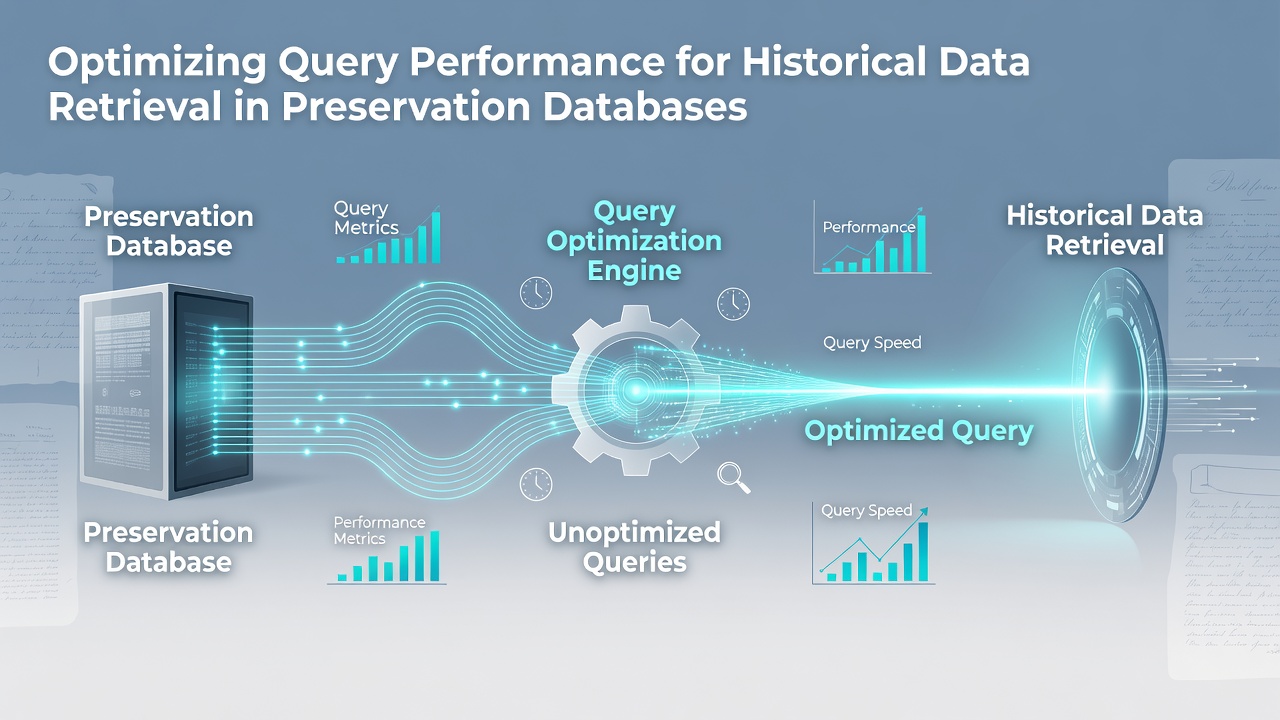
Preservation databases store extensive records across decades and retrieval operations often require scanning time-series data that spans multiple formats and structures, so performance optimization begins with targeted indexing on timestamp fields combined with composite keys that incorporate metadata categories such as record type and originating institution.
Database administrators apply range partitioning by date intervals to isolate older segments while keeping recent entries in active tables, and this approach reduces I/O overhead because queries targeting specific eras access only relevant partitions rather than the entire dataset.
Indexing and Query Planning Techniques
Administrators create partial indexes that cover frequently accessed historical windows, and execution planners then select these indexes when predicates match the defined ranges, which shortens planning time and improves throughput on repeated retrieval patterns.
Studies from the National Archives of Australia show that combining B-tree indexes on primary temporal columns with bitmap indexes on categorical attributes accelerates filter operations by up to forty percent in large archives, while query rewrite rules convert complex joins into materialized views refreshed on a scheduled basis.
Partitioning Strategies and Storage Layouts
Time-based partitioning divides tables into monthly or yearly segments stored on separate filegroups, and administrators move older partitions to slower, cost-effective storage tiers without affecting active query paths. This layout allows maintenance tasks such as vacuuming or statistics updates to run on individual partitions, limiting lock contention during peak retrieval hours.
Compression algorithms applied at the partition level shrink historical blocks by sixty to seventy percent according to benchmarks released by Library and Archives Canada, and the reduced footprint permits more data to reside in memory caches during analytical workloads.
Caching Layers and Asynchronous Processing
Read replicas configured with result-set caching store outputs from common historical queries, and cache invalidation triggers activate when underlying partitions receive updates or corrections. Asynchronous background jobs precompute aggregates for decade-long summaries, delivering pre-aggregated results to users who request trend analysis instead of raw row sets.
As of October 2026, several institutions report integrating vector-based similarity search alongside traditional SQL methods to locate contextually related records even when exact metadata matches are absent, and these hybrid approaches rely on embedding models trained on archival descriptions to surface relevant items faster than full-text scans alone.
Monitoring and Continuous Tuning
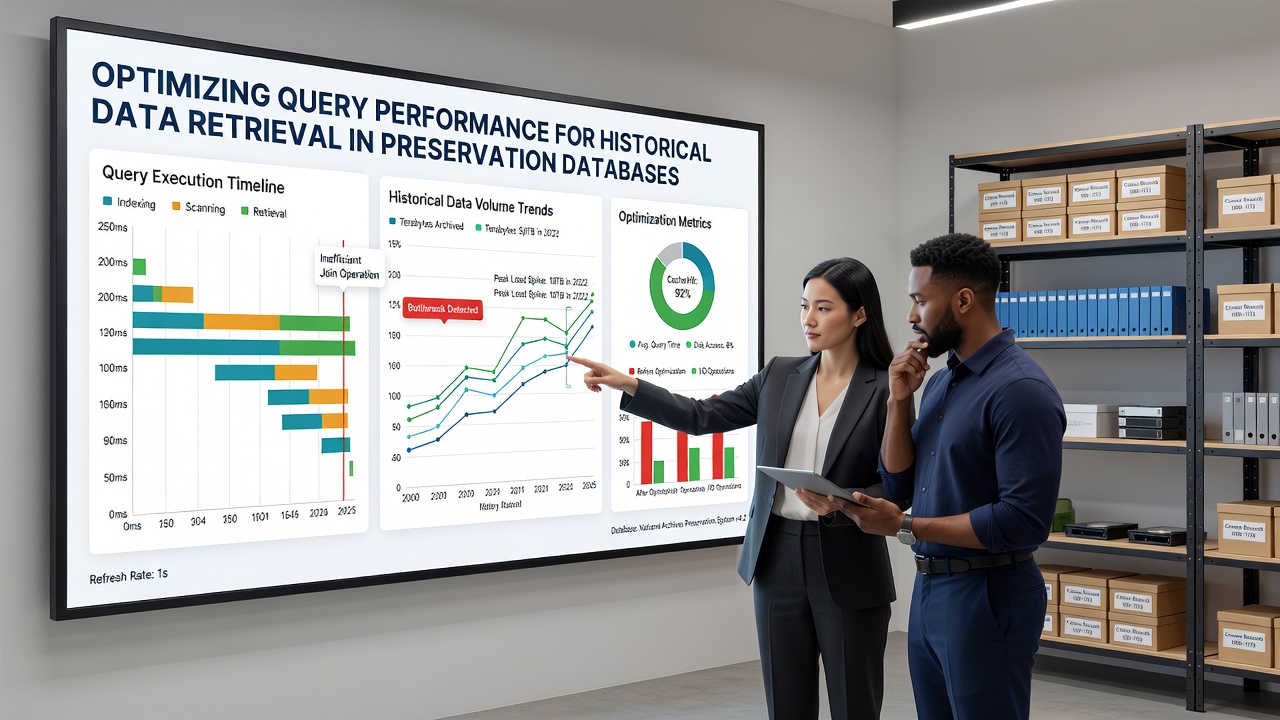
Performance dashboards track query latency percentiles and partition scan ratios, while automated alerts notify teams when execution times exceed baseline thresholds established during initial load tests. Regular review of slow-query logs reveals opportunities to adjust statistics sampling rates or introduce covering indexes that eliminate table lookups entirely.
Research published by teh German Federal Archives indicates that institutions adopting automated index recommendation engines reduce manual tuning effort by half, because machine-learning models analyze workload traces and propose index candidates ranked by estimated impact on retrieval speed.
Conclusion
Effective optimization combines thoughtful partitioning, selective indexing, layered caching, and ongoing monitoring to maintain responsive access to historical records, and organizations that implement these layered techniques sustain acceptable query times even as archive sizes continue to expand.