Sam Zimmermann · 6 September 2026
Navigating Redundancy Mechanisms for Long-Term Digital Archive Stability in Changing Infrastructures
Digital archives face ongoing pressures from infrastructure shifts that include hardware upgrades, software migrations, and evolving storage standards, yet redundancy mechanisms provide structured approaches to maintain data integrity across these transitions. Researchers at institutions focused on preservation note that combining multiple layers of duplication with automated verification helps organizations address risks tied to single points of failure. Data from the Library of Congress shows that systematic replication across geographically separated sites reduces loss rates during facility-level disruptions.
Core Redundancy Approaches in Archive Systems
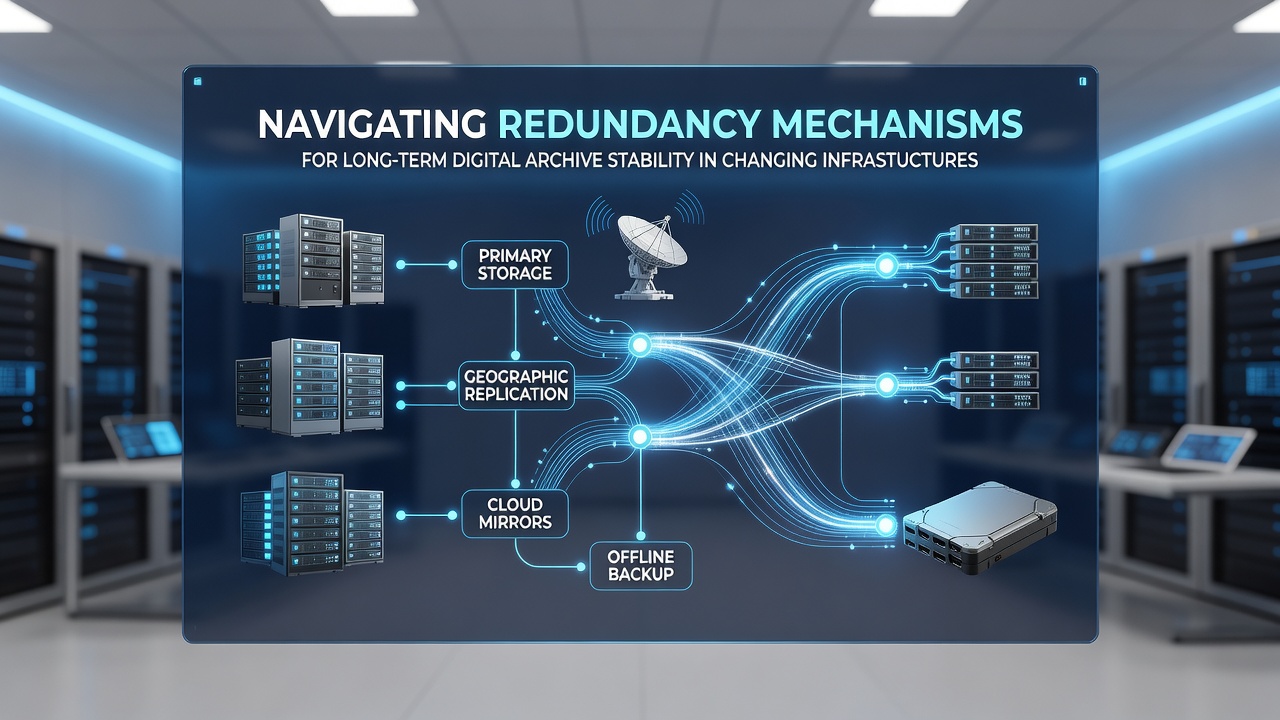
Organizations deploy several established redundancy strategies, and these often operate in parallel to cover different failure modes. Replication creates identical copies at multiple locations while erasure coding distributes data fragments with parity information so that reconstruction remains possible even when portions become unavailable. Experts observe that hybrid models combining both methods deliver higher resilience in environments where network latency and storage costs vary. According to reports from the National Archives of Australia, such layered systems have supported continuous access to records during hardware refresh cycles that occurred between 2023 and 2025.
Monitoring plays an essential role because redundancy only functions when errors are detected early. Automated checksum verification runs at regular intervals, and systems flag inconsistencies before they propagate. Studies from Canadian research centers indicate that daily integrity checks catch the majority of bit-rot incidents within the first month of occurrence, allowing corrective copies to restore affected segments without manual intervention.
Adapting Mechanisms During Infrastructure Transitions
When organizations move archives between cloud providers or on-premises platforms, redundancy protocols must accommodate temporary inconsistencies. Migration workflows typically maintain dual active copies until the new environment reaches full synchronization, after which older instances are decommissioned through controlled processes. Observers note that phased cutovers, supported by versioned snapshots, limit exposure windows compared with full simultaneous switches.
Format obsolescence adds another dimension because storage media and file standards continue to evolve. Redundancy extends beyond physical copies to include format migration schedules that convert content to current standards while preserving originals for verification. Figures from the European Commission’s digital preservation initiatives reveal that institutions maintaining parallel format versions experience fewer access interruptions when legacy software reaches end-of-life.
Geographic and Environmental Considerations
Distributing copies across regions accounts for natural disasters, power outages, and regulatory changes that affect single jurisdictions. Multi-site architectures place data in facilities separated by hundreds of kilometers, and network protocols ensure consistency despite varying bandwidth. Research indicates that archives using three or more geographic zones maintain higher availability metrics during regional events compared with two-zone setups.
Energy and cooling requirements also influence redundancy planning because additional copies increase overall consumption. Facilities that adopt tiered storage, keeping frequently accessed records on faster media and archival copies on tape or optical systems, balance redundancy with operational efficiency. Data collected through 2025 demonstrates measurable reductions in power draw when such tiering accompanies geographic distribution.
Verification and Recovery Protocols
Regular testing of recovery procedures validates that redundancy mechanisms perform as designed under realistic conditions. Organizations schedule simulated failures that include node outages and link disruptions, then measure restoration times against defined targets. Reports compiled by preservation consortia show that institutions conducting quarterly drills identify configuration drift earlier than those relying solely on automated alerts.
September 2026 brings updated guidelines from several international bodies that emphasize integration of artificial-intelligence-assisted anomaly detection into existing verification pipelines, and these updates align with observed increases in storage density that raise the stakes for undetected errors. Implementation timelines vary by organization size yet follow similar patterns of pilot programs followed by phased rollout.
Conclusion
Redundancy mechanisms for long-term digital archives require continuous adjustment as infrastructures change, and the combination of replication, erasure coding, geographic distribution, and rigorous verification forms the foundation for sustained stability. Organizations that align these components with migration planning and format management maintain access to records across decades. Ongoing data collection from multiple national archives continues to refine best practices as storage technologies advance.